
A Score Isn’t a Verdict: Using an AI Face Rater as a Photo Lab
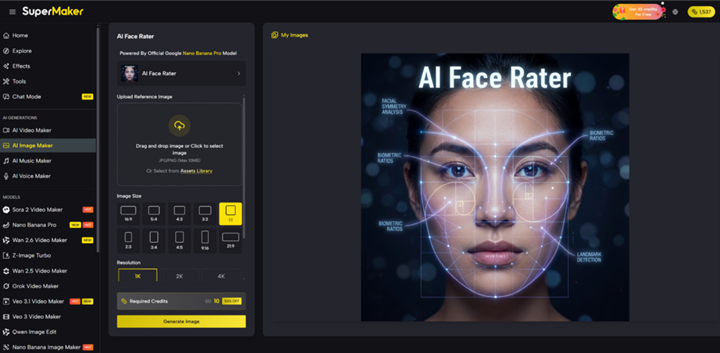
If you’ve ever deleted a selfie and thought, “I look different every time,” you’re not imagining it. Cameras exaggerate small changes—lighting, lens distance, head tilt—until your face feels inconsistent, even though it hasn’t changed. That’s the exact problem I wanted to test when I used AI Face Rater. I wasn’t looking for approval. I wanted a controlled way to answer a practical question: what variables are actually driving how a face looks in photos?
In that sense, an AI face rater can be treated less like a beauty contest and more like a small “photo lab”: you keep the subject constant (your face) and adjust the inputs (lighting, angle, expression) to see what shifts the output.
What an AI Face Rater Really Measures (And What It Doesn’t)
At its core, a face rater isn’t “seeing” you the way people do. It’s analyzing a 2D image by locating facial landmarks and computing relationships between them.
That distinction matters.
What it tends to measure well
- Landmark placement (eyes, nose, mouth, jawline)
- Symmetry and alignment (left vs right)
- Proportion patterns (relative distances and ratios)
- Photo-to-photo consistency when conditions stay similar
What it cannot truly measure
- Personality, style, presence, voice
- Movement and micro-expressions in real interaction
- Social context (how you’re perceived in different settings)
- Cultural preference, personal taste, or “type”
So the most useful mindset is: the score is a summary of *measurable geometry under current photo conditions*, not a statement of your worth.
How SuperMaker’s AI Face Rater Operates (User-Level View)
The experience is straightforward:
- Upload a selfie (clear, front-facing works best as a baseline)
- The system detects facial landmarks
- It computes symmetry and proportion-based metrics
- It outputs an overall score plus written analysis
The product positioning emphasizes speed and simplicity—upload, analyze, review—so even if you’re not technical, you can run repeated tests quickly.
My Alternative Test: Turning the Tool Into a “Controlled Experiment”
Instead of uploading one photo and accepting the result, I ran a small experiment with a consistent setup.
My setup
- Same room, same spot
- Same camera
- Same distance from the phone
- Only one variable changed per photo
What I changed (one at a time)
- Lighting direction (front light vs overhead)
- Head angle (straight vs slight turn)
- Expression (neutral vs small smile)
This approach immediately made the results more interpretable. When the score shifted, it was easier to attribute the change to the specific variable I adjusted.
It also made something obvious: a face rater often reacts strongly to *photography mechanics*, not “real attractiveness.”
The Biggest Driver I Saw: Lighting, Not Features
I expected symmetry and pose to matter most. But in my trials, lighting was the most powerful lever.
- Overhead light created harsher shadows, especially around eyes and under cheekbones.
- Front lighting smoothed transitions and made landmark detection feel more stable.
- Uneven side lighting sometimes made one half of the face “read” differently.
This doesn’t mean the AI was “wrong.” It means the AI is highly sensitive to what the camera captures—exactly as it should be if its job is to score what’s in the photo.
How This Compares to Other Ways People Judge Photos
If you’re deciding whether this tool is worth using, it helps to compare it to alternatives:
| Comparison Item | AI Face Rater Free Online | “Hot or Not” Style Apps | Self-Judgment in the Moment | Friends / Social Comments |
| Repeatability | High if you control photo conditions | Often inconsistent | Low (mood-driven) | Low (context-driven) |
| Signal Quality | Geometry + proportion patterns | Entertainment scoring | Harsh, selective attention | Polite bias, social filters |
| Actionability | Clear: change lighting/angle and retest | Limited guidance | Usually spirals into overthinking | Vague (“this one’s nice”) |
| Time Efficiency | Fast feedback loop | Fast but noisy | Slow and stressful | Slow and dependent |
| Best Use Case | Photo optimization + tracking | Fun content | Rarely constructive | Social validation |
Where AI Face Ratings Can Be Useful (Without Becoming Toxic)
Used carefully, a rater can help with practical goals:
1. Photo consistency
If you want a reliable profile photo style, testing consistent lighting and angles can help you find what works.
2. Makeup and grooming experiments
Instead of relying on vague impressions, you can compare versions under similar conditions and observe patterns.
3. Content creation
If you’re making transformation content or photography tips, a consistent scoring method can provide a structured storyline.
4. Habit tracking
If you’re tracking sleep, stress, or skincare changes, the score can become one small data point—never the whole narrative.
Important Limitations (That Actually Make It More Believable)
A face rater that admits limitations feels more trustworthy than one that promises perfection.
1. Image quality changes the outcome
Blurry photos, heavy beauty filters, or low light can destabilize landmark detection and shift results.
2. Pose and expression are not neutral
Even a slight head tilt changes relative distances in 2D space. Smiles change mouth and cheek geometry.
3. Scores compress complex perception into one number
A single score can’t represent how you look in motion or how you are perceived in real interaction.
4. Dataset and cultural bias can exist
Any system trained on human-labeled aesthetic data can reflect biases. Treat the output as a tool-generated opinion, not an objective truth.
How to Use AI Face Rater Like a Professional (Simple Protocol)
If you want meaningful comparisons, treat it like a measurement routine:
Step 1: Create a baseline
- Neutral expression
- Front-facing
- Soft, even lighting
Step 2: Test one variable at a time
- Change only lighting direction, or only head angle, or only expression
Step 3: Look for patterns, not perfection
- Ask: “What consistently improves the photo readout?”
- Not: “What score proves I’m attractive?”
This turns the tool into an educational loop instead of a self-esteem trap.
A More Mature Interpretation of the Score
Here’s the most helpful framing I found:
- If your score improves when lighting improves, that’s not “cheating.” It’s photography.
- If your score drops with overhead lighting, that’s not “you.” It’s shadows and angles.
- If two similar photos score differently, that’s a sign you should tighten the testing conditions.
In my own use, the score became less emotional over time. It started to feel like checking a camera setting rather than checking my value.
What This Tool’s Potential Really Is
AI Video Generator Agent is most compelling when you approach it as a clarity tool—a fast way to learn how photo variables shape perception. It can help you identify what’s consistent, what’s accidental, and what’s simply the camera being dramatic.
If you want a grounded, realistic outcome, aim for this:
- Use it to refine photos, not to define yourself.
- Use it to compare setups, not to chase a number.
- Use it as a mirror with measurements, not a judge with a verdict.