
If You Think You “Need a Producer” to Start, an AI Song Generator Can Be a Practical First Step
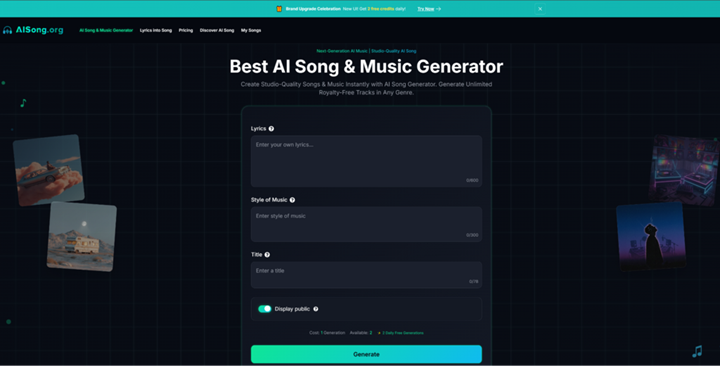
There’s a common misconception about making music: that you either do it “properly” with a DAW and production skills, or you don’t do it at all. In reality, most creative work starts long before the final mix. It starts with a draft you can react to—something audible that turns a vague intention into a concrete direction. That’s where an AI Song Generator can be genuinely helpful. In my own use, it didn’t feel like a replacement for a producer. It felt like a way to arrive at the kind of rough demo you would normally need time, tools, or help to create.
What made the experience valuable was not that every output was great. It was that I could move from “I want it to feel like this” to “this is close, but adjust these two things” in a single sitting.
A New Way to Frame It: The Tool Produces “Editable Decisions”
The most useful output from a generator is not “a song.” It is a decision you can defend:
- “This tempo works.”
- “This palette (guitar + warm bass + tight drums) fits.”
- “The chorus needs more lift.”
- “The rhythm is too busy under voiceover.”
In my tests, a decent draft did something important: it gave me a stable target. Even when I didn’t keep the exact output, I kept what I learned from it.
What It’s Doing Under the Hood (As Far as the User Needs to Care)
You provide either a text description or lyrics, and the generator produces an audio draft by combining musical building blocks:
- Melody: the lead motif or hook idea
- Harmony: chord movement and tonal color
- Rhythm: groove and pacing
- Arrangement: how sections enter, build, and resolve
The key point is not the internals; it’s the workflow: your text becomes a brief, and the brief becomes something you can audition quickly.
Three Entry Styles (Pick the One That Matches Your Goal)
1) “Background Bed” Mode (For Content and Voiceover)
If you want music that supports narration, the prompt should say that explicitly. In my experience, drafts improved when I asked for:
- restrained melodic density
- steady groove
- fewer attention-grabbing transitions
My observation:
When I didn’t specify “space for voiceover,” the output sometimes filled every gap with melodic movement—musically interesting, but not always useful.
2) “Theme Sketch” Mode (For Products, Games, and Brands)
Here the goal is not a finished track, but a sonic identity direction:
- bright vs warm
- modern vs organic
- intimate vs cinematic
My observation:
The fastest way to make progress was to generate several variations that differ by only one axis: tempo or instrument palette or energy curve.
3) “Lyric Performance Test” Mode (For Songwriters)
If you already have lyrics, AI Song Maker can help you discover what doesn’t show up on paper:
- awkward syllable clusters
- lines that don’t breathe
- choruses that are too dense to sing clearly
My observation:
Small lyric edits—shorter lines, clearer stresses—often helped more than changing genres.
Comparison Table: Honest Placement in the Toolchain
| Need | AI Song Generator | DAW workflow | Producer/composer | Stock music |
| First draft you can react to | Fast (often minutes; may require iterations) | Slower (setup + skill) | Medium (turnaround time) | Instant but fixed |
| Many options quickly | Strong | Labor-intensive | Limited | Limited |
| Precise editing control | Limited | Strong | Strong | None |
| Consistency and repeatability | Medium (prompt-sensitive) | High | High | High |
| Best use stage | Ideation + drafts | Refinement + finishing | High-stakes finalization | Quick background use |
| Common tradeoff | Selection + iteration | Time + expertise | Cost + coordination | Generic feel |
What Improved My Output Quality Without Adding More Effort
A: I wrote prompts like a production brief
Instead of “make it inspiring,” I used:
- genre + tempo
- instrument palette
- energy curve
- structure hint
- avoid list
B: I used a “two-pass” generation approach
- pass 1: generate 2–3 drafts with the same prompt to understand variance
- pass 2: change one variable and generate again to learn cause-and-effect
C: I used an avoid list to reduce unwanted surprises
In practice, this was a leverage point:
- avoid harsh distortion
- avoid busy hi-hats
- avoid abrupt drops
- avoid overly bright lead tones
Limitations (Stated in a Way That Matches Real Use)
Expect variation
The same prompt can produce different results. That can be useful for exploration, but it means you should plan to choose between drafts.
Expect multiple generations
Especially for more complex genre blends, it may take several attempts to land on a coherent groove and arrangement.
Vocals vary more than instrumentals
When vocals are included, intelligibility and phrasing can fluctuate. Lyrics with consistent meter tend to reduce this problem.
Commercial use deserves careful reading
If you intend to monetize or distribute, treat licensing and usage terms as something to verify. “Royalty-free” language is not a substitute for plan-specific permissions.
A Neutral Reference (For a Broader, Non-Hype View)
If you want a measured overview of AI Song progress in creative domains, neutral reporting such as Stanford’s AI Index can provide context on capability trends and adoption—without turning the discussion into marketing.
Who This Helps Most
High value
- creators shipping frequent media who need fast drafts
- lyric writers who want to test cadence quickly
- teams exploring brand mood before commissioning a final track
- indie builders prototyping soundscapes
Lower value
- work requiring surgical arrangement control
- signature releases where the producer’s interpretation is central
- projects that must match a very specific reference track exactly
Closing: Why This Can Be a Calm Way to Start
The tool’s best use is not as a finish line, but as a first step. It reduces the intimidation of starting, because you don’t need to “know everything” before you can hear something. In my testing, the biggest practical gain was lowering the cost of exploration. Once you can audition a direction, you can refine it—by better prompts, by lyric edits, or by handing a clear demo to a human producer.
A final workflow tip
If you want faster improvement, do not rewrite the entire prompt. Change one variable per iteration, listen, and keep notes. That turns the generator into a predictable drafting process rather than a random generator.